10-Minute No-Sew Lavender Sachets: The Quarter-Cup Rule That Keeps Them Smelling
I have a drawer of scarves that used to smell like a garden and now smells like a drawer. Somewhere in it are three lavender sachets I made two winters ago. They are still lavender. They are still in there. They just stopped doing the one job they had, and for the longest time I assumed that was simply what happened to lavender: it fades, you throw it out, you buy more.
That is not what happened. I had packed them wrong, and I had packed them wrong in a way that is hard to spot, because a badly made sachet looks better than a good one. It is plumper. It is firmer. It sits in the drawer looking like a little pillow, and it is completely mute.
The other half of the problem was the sewing. Every no-sew sachet I tried either ran out of fabric right at the neck, so the tie sat on a stub and slipped off inside a week, or it spilled a slow trickle of buds into the drawer every time I moved it. I was blaming my knots. It was never the knots. It was the ratio between how much I was putting in and how big the square was, and there is a number for it.
What we are making
A gathered sachet. One square of fabric, a scoop of filling in the middle, the corners pulled up into a little bundle, and a ribbon tied around the neck. No sewing machine, no needle, no hemming, no turning anything right side out. If you can tie a shoelace you can make one, and the whole batch takes about ten minutes.
They are the most reliable small gift I make. Everyone has a drawer. Nobody has ever opened one and been disappointed. And unlike most handmade gifts, a good one keeps working for a year or more, which is the whole point of getting it right the first time.
The rule: a quarter cup in a 5 inch square
Four level tablespoons of filling, into a square of fabric with 5 inch sides. That is the recipe. Two separate reasons sit behind it, one about the fabric and one about the smell. They are worth keeping apart in your head, because most advice muddles them.
The square size decides whether you can tie it. The fill decides whether it smells.
Why 5 inches, and not 4
The fabric is doing something worth thirty seconds of your attention, because it explains a failure you have probably had.
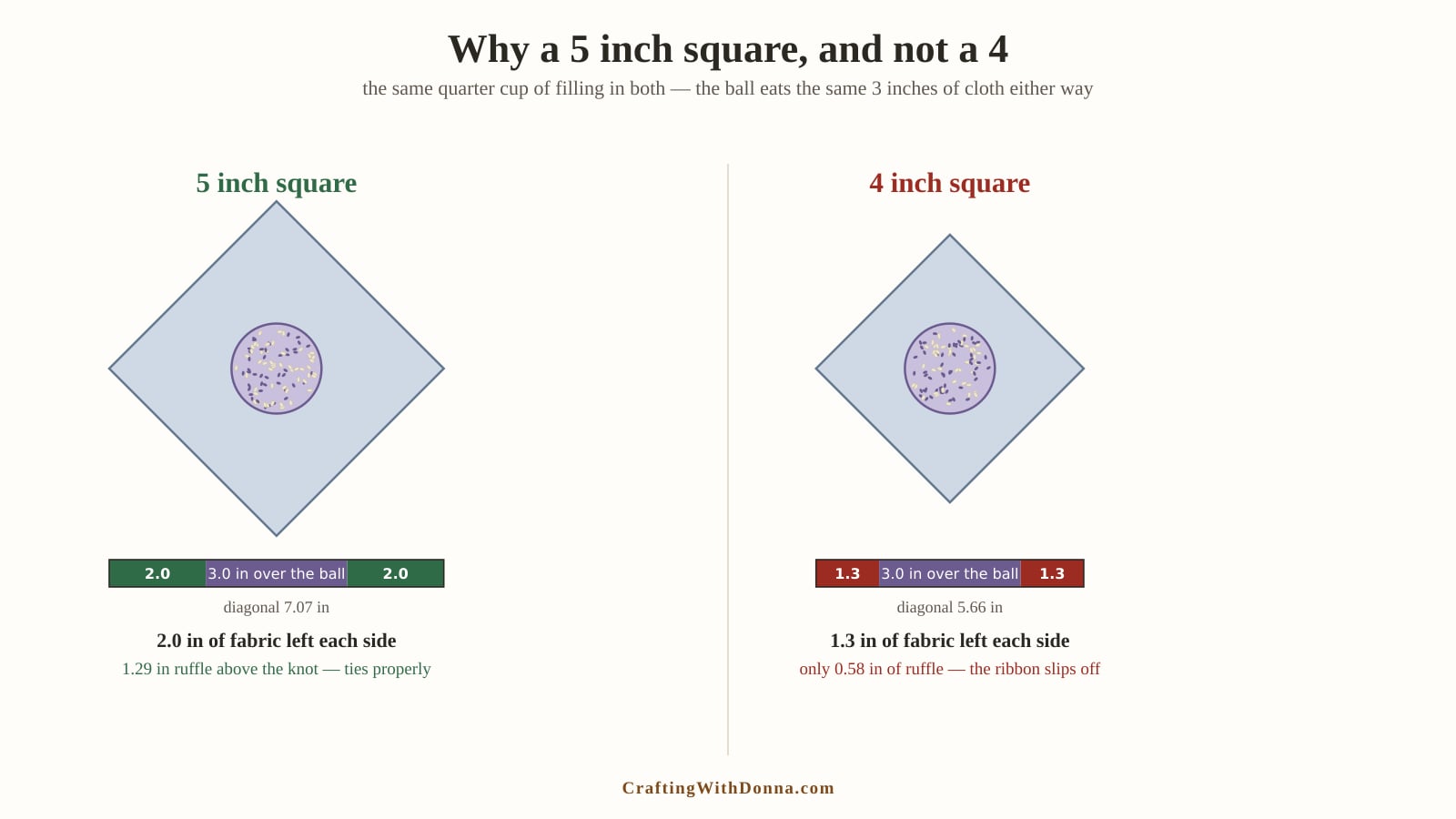
A quarter cup of lavender and rice, gathered up, settles into a ball a shade under 2 inches across. The fabric has to travel over that ball to get from one corner of the square to the opposite one, and going over the top of a 2 inch ball uses about 3 inches of cloth, which is just half the way around it.
So the question is how long your diagonal is, and a square’s diagonal is a lot shorter than people guess:
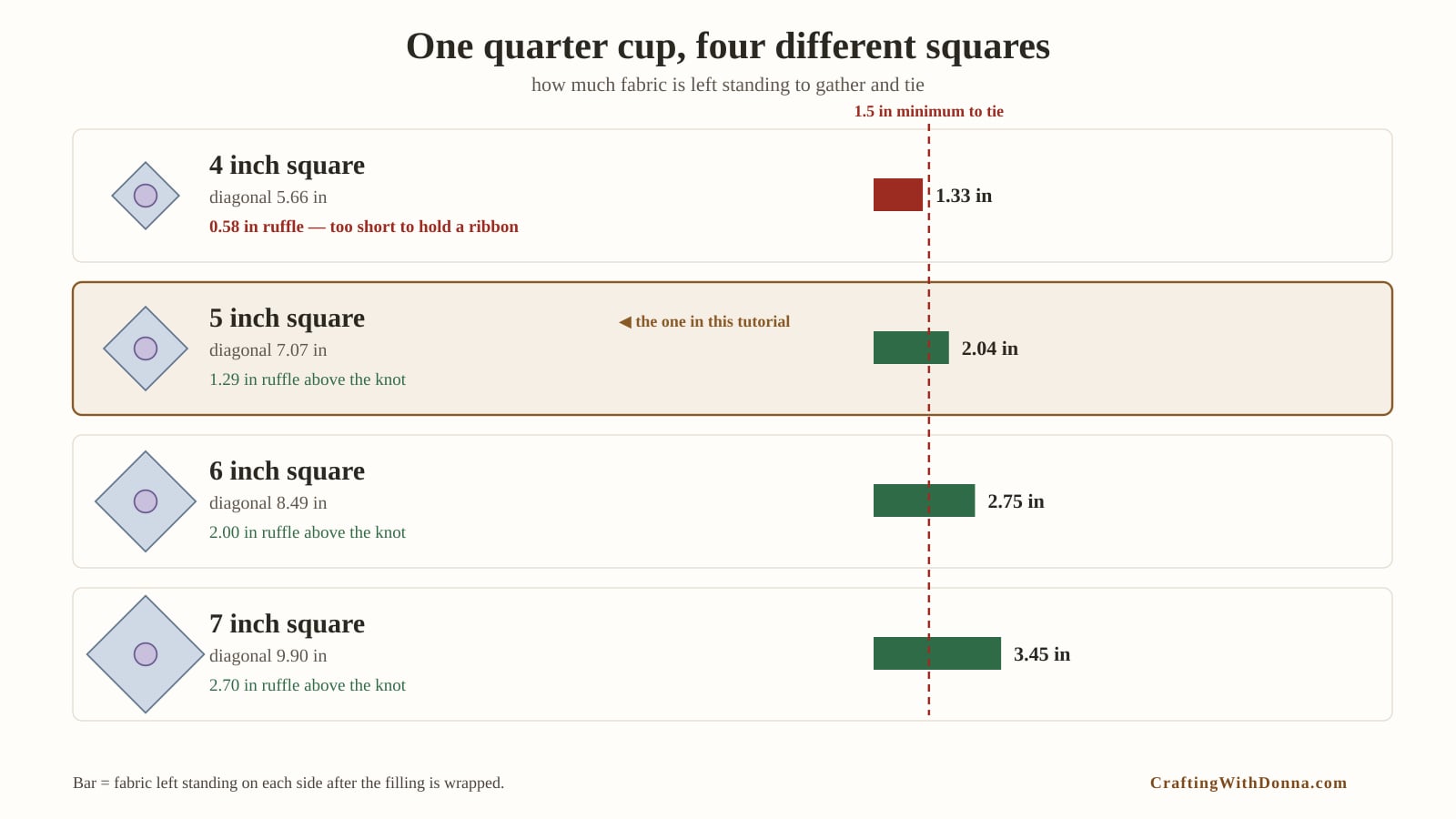
- A 5 inch square measures 7.07 inches corner to corner. Take away the 3 inches spent wrapping and 4 inches are left, split between two opposite corners: 2 inches of fabric standing up on every side. Tie three quarters of an inch above the ball and you still have an inch and a quarter flaring out above the knot. A proper ruffle.
- A 4 inch square measures only 5.66 inches. The ball still eats its 3 inches, because it does not care how big your square is, so you are left with just 1.3 inches a side. After the tie, that is barely half an inch of ruffle. That is the stubby little bundle the ribbon works its way off, and it is why my early ones spilled.
An inch of square is not an inch of usable fabric. It is about an inch and a half of diagonal, and the diagonal is the part you tie with. That one fact is the whole reason a 5 inch square is the smallest one worth using.
Going bigger is never a fabric problem. A 6 inch square leaves 2.75 inches a side, and a 7 inch leaves nearly three and a half. It just gets floppy and starts looking like a laundry sack. Five is the sweet spot for a drawer sachet; six if you want a showier ruffle.
Why a quarter cup, and not more
Now the part that explains my mute scarf drawer, and let me be straight about something first, because it is the opposite of what you would expect.
Overfilling a 5 inch square does not run you out of fabric. I checked, because I assumed it did. You could put three times the recommended filling in and still have nearly an inch and a half a side to tie with. The bundle would be a fat, hard little thing, but it would tie.
It would also be silent, and that is the real cost.
Dried lavender does not evaporate into a room. The scent lives in oil held inside the buds, and it only comes out when the buds break. That is why a lavender field smells of very little until you walk through it. Every time you pick up a sachet with room inside it, the buds roll over each other, a few break, and the drawer gets a fresh dose. A sachet packed to the edges cannot do that. The buds are wedged. Nothing moves, nothing crushes, nothing releases, and within a fortnight you have a firm little cushion that smells of fabric.
So a quarter cup is not a fabric measurement at all. It is the biggest scoop that still leaves the filling loose enough to work.
My test for it has no numbers in it whatsoever. Pick the finished sachet up and squash it flat between finger and thumb. It should give, easily, and you should hear a faint crackle. If it feels like a beanbag and holds the shape you left it in, take some out. Then smell your fingers. That is what the drawer is about to get.
Cut the lavender with rice
Two of the four tablespoons are dried lavender. The other two are plain uncooked rice, and I would not skip it even if lavender were free.
Rice does three things. It gives the sachet enough weight to sit down in among folded clothes instead of riding up to the top of the pile. It fills out the shape, so the bundle looks like a bundle rather than a sad twist. And it slides, which keeps the buds loose and rolling against each other, which is exactly the movement that keeps releasing scent. Lavender on its own knits together into a dense mat surprisingly fast.
It also doubles what a bag of lavender buds makes for you. A cup of buds at two tablespoons a sachet gives you eight sachets, which is a gift for everyone you had in mind and two spare.
Use plain long grain white rice, and use it dry from the box. Not instant, not cooked, obviously, and not brown rice, which carries more oil and can go stale-smelling over a long year in a warm drawer.
What to cut, and what to cut it from
Fabric: a 5 inch square. Anything closely woven and thin. Quilting cotton is perfect. So is an old cotton shirt, a pillowcase past its best, or a linen napkin that lost its partner.
There is a happy accident here worth knowing about. A quilting charm pack is a bundle of pre-cut 5 inch squares in coordinating prints, sold by the stack. That is this project’s exact measurement, already cut, already color-matched, with pinked edges that do not fray. A charm pack and a bag of buds is a whole afternoon of gifts with no cutting at all.
If you are cutting your own, pinking shears are worth it. A straight-cut edge on woven cotton will fray into the ruffle over a year of being picked up. Pinked edges hold. If you only have straight scissors, cut the squares and leave them. A little fraying at the very top is fine, and it tends to look intentional.
Fabric weight matters more than you would think. Muslin, quilting cotton, thin linen, lawn: all good. Skip felt, fleece, denim and canvas. They are too thick to gather into a neck, so you get a stiff funnel that will not close, and too dense for the scent to pass through, which defeats the object twice over.
Ribbon: 10 inches. The gathered neck pinches down to about an inch across, so it takes roughly 3 inches of ribbon to go around it. Ten inches leaves you just under 7 inches for the bow, which is enough for a generous one with tails. Narrow ribbon, a quarter inch or less, pulls into a tight neck better than wide ribbon, which wants to fold and slip. Baker’s twine, embroidery floss and thin jute all work and all look good.
Making one, start to finish
- Lay the square face down. Whatever side you want on the outside goes against the table. The inside becomes the outside when you gather it, and I have got this backwards more than once.
- Mix your filling. Two tablespoons of lavender and two of rice, stirred together in a cup. Mix the whole batch at once if you are making several: a cup of lavender and a cup of rice, stirred, then a quarter cup scooped out per sachet.
- Pour it into the middle. Aim for the center. Filling that lands off center means one corner runs short of fabric while the opposite one has plenty, and it is the short one that decides whether the tie holds.
- Lift the four corners straight up. All four together, one hand, like closing a small parcel. Do not twist yet. The filling should settle itself into a ball at the bottom.
- Gather the sides in. Run your other hand around the outside and pull in the four loose bits of fabric between the corners, so all eight points are held in one bunch. This is what makes the neck round instead of square.
- Pinch the neck three quarters of an inch above the filling. Roughly a thumb’s width. You will feel where the ball stops and the loose fabric starts, so pinch just above that.
- Wrap the ribbon twice and tie. Two wraps, not one. One wrap slides down over time as the fabric relaxes; two grip each other and hold. Pull it firm, then knot, then bow.
- Fluff the ruffle. Open the points out above the knot with your fingers so they spread instead of lying flat in one direction. Ten seconds, and it is the difference between a homemade gift and a handmade one.
- Squash test. Flatten it between finger and thumb. Give, and a faint crackle. If not, untie and take a spoonful out.
Keeping them alive
A well-made sachet still fades eventually, and there is a two-second fix that most people never hear about: squeeze it. Every few weeks, pick it up and roll it firmly between both palms. You are breaking open a new layer of buds. It comes back, immediately, and it will do this for a year or more, which is only possible because you left the room inside for the buds to move.
When squeezing stops bringing it back, do not throw the sachet away. Untie the ribbon, tip the filling into the compost, and refill the same square. The fabric and the ribbon are fine. I am on the third life of a couple of mine.
If you want to stretch it further, a single drop of lavender essential oil on the rice (on the rice, not the buds, because rice holds oil and buds do not) will revive a tired batch. One drop per sachet. Two makes it smell like a cleaning cupboard, and I speak from experience.
If yours is not right
The tie slipped off and there are buds in the drawer. One wrap instead of two, almost always. Fabric relaxes over a few weeks and a single wrap works its way loose. Re-tie with two wraps.
It will not close into a neck, it makes a stiff funnel. Your fabric is too heavy. Felt and fleece do this. Same filling, thinner cloth.
The ruffle is a stub and the ribbon keeps riding up over it. Your square is too small, not your scoop too big. A quarter cup in a 4 inch square leaves about half an inch of ruffle above the knot, which is not enough to hold a ribbon. Cut 5 inch squares and the same filling gives you an inch and a quarter.
It smelled wonderful for a week and then nothing. Packed too tight. Do the squash test. If it does not give, it cannot release.
It looks lopsided. The filling went in off center. Untie, shake the ball back to the middle, and gather again. Twenty seconds.
Fine dust is coming through the weave. Your cotton is loosely woven, or the buds were very dry and broke up in mixing. Double the fabric, two squares stacked and treated as one, and it stops.
Once you have the ratio, change everything else
The quarter cup in a 5 inch square holds no matter what you put in it, because it is about volume, not ingredients.
- Cedar and lavender, half and half in place of the buds, for a wool drawer. Cedar handles moths; lavender handles the smell of cedar.
- Dried rose petals with a little lavender for a lighter, less medicinal sachet. Petals are bulkier, so measure by the quarter cup rather than by weight.
- Balsam fir needles for the winter gift version. They are the smell of a Christmas tree and they last for years.
- Rice and lavender warmed for twenty seconds in a microwave, but only if you have tied it with cotton string rather than polyester ribbon, and only in a sachet made of pure cotton. Check both. This is the version people keep on the back of their neck.
- A 6 inch square with 6 tablespoons if you want a larger sachet for a closet rather than a drawer. Scale the fill by feel rather than by formula, since the squash test is still the judge, and the bigger square leaves you an even more generous ruffle.
Ten minutes, honestly
Mixing a batch of filling is two minutes. Cutting six squares is three, or zero if you bought a charm pack. Each sachet is under a minute once you have made one: pour, lift, gather, pinch, tie, fluff. Six of them, boxed and ribboned, inside ten minutes.
The first one takes longer, because you will make it too full. Everyone does. That is what the squash test is for.
What you need
Some of the links below are affiliate links. If you buy through one, Crafting With Donna may earn a small commission at no extra cost to you.
- Dried lavender buds, buy culinary grade even though nobody is eating it, because it is cleaner and better dried. A pound is a lot of sachets
- A 5 inch charm pack, pre-cut to exactly the size this project wants, already coordinated, edges already pinked
- Unbleached muslin by the yard, the cheap route if you would rather cut your own, and it suits a plain rustic sachet
- Pinking shears, the zigzag edge is what stops the ruffle fraying over a year of being picked up
- Narrow satin ribbon, a quarter inch or less pulls into the neck properly. Wide ribbon folds and slips
- Baker’s twine, the cotton alternative, and the one to use if you want the warmable version
- Lavender essential oil, one drop on the rice brings a tired batch back
- Cedar chips, for the wool drawer version
Get the free fill chart
I put together the one-page sheet I wish I had had two winters ago. Most of it is a true-size 5 inch cutting square, printed at actual size so you can lay your fabric straight on top of it and cut around it without measuring anything. Inside that square is a circle drawn to the exact size a quarter cup makes, so you can check your scoop against it before you pour. Beside them is the table for all four square sizes, the eight-step gather sequence written out, and the squash test in a box you cannot miss.
Print it at 100 percent rather than “fit to page”, or the cutting square stops being 5 inches. It says so across the top of the sheet so you cannot forget.
Download the Lavender Sachet Fill Chart (free PDF)
One page, US Letter. Print at 100 percent, not “fit to page.”
Go and find the shirt you were never going to wear again. That is your first six sachets, and the drawer they are going into has been waiting a while.
Plan the next four cozy craft nights
If this ten-minute project is your kind of evening, the printable Craft Night Kit Planner turns one short planning session into four ready-to-go craft nights, including supplies and a master shopping list. It is $7 in the Crafting With Donna shop.